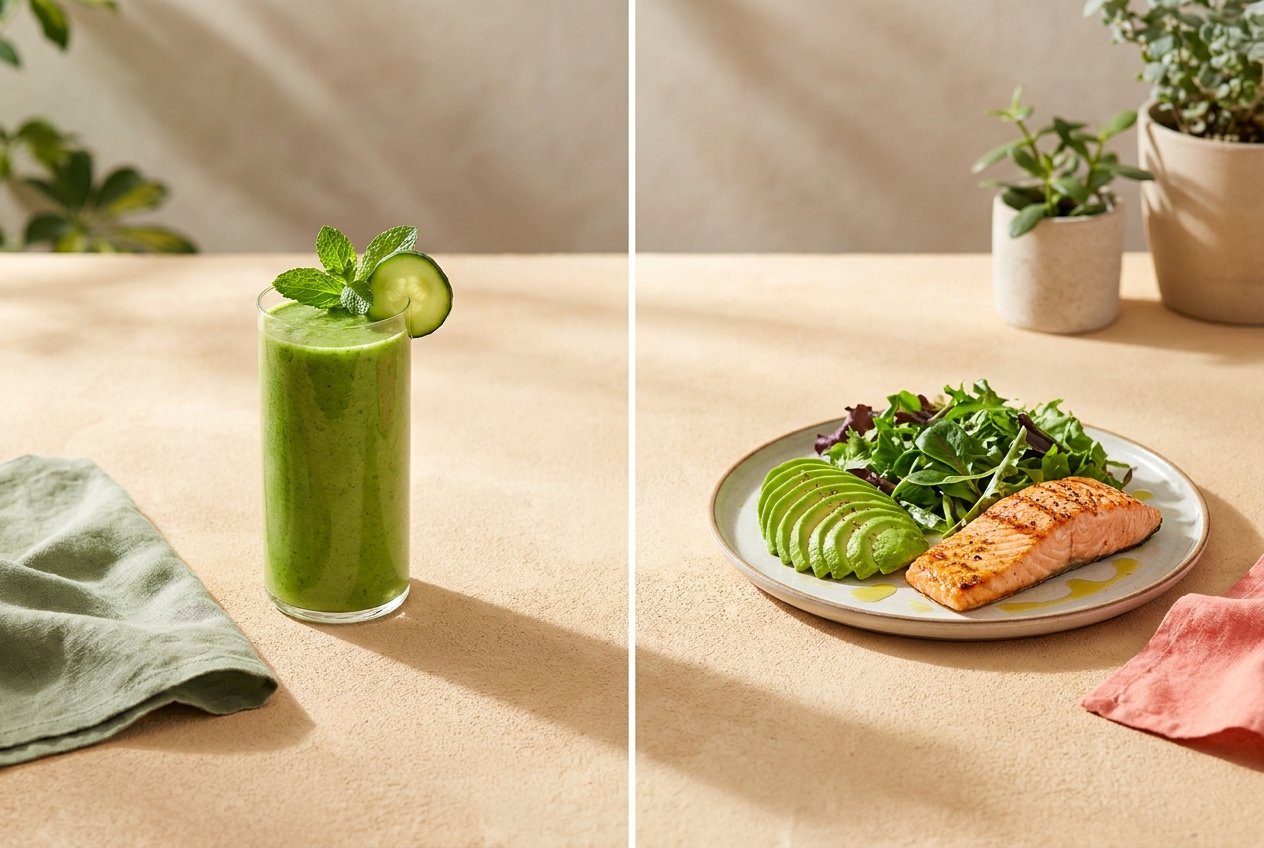
If you have narrowed your search to The Smoothie Diet and the Custom Keto Diet, you are choosing between two of the most advertised meal plans on the internet, and the ads are no help at all. Both promise transformation. Neither mentions what your actual week looks like: the work lunches, the school schedules, the family members who expect dinner to be food they recognize.
This comparison is based on our research into both programs’ materials, structure, and user feedback, not on a personal test, and we will keep the marketing out of it. Here is how the two plans stack up on price, effort, food, and the thing nobody advertises: what happens when the program ends. All of it through an over-40 lens, because that is who we write for.
The Short Answer
Pick The Smoothie Diet if you hate cooking, want a short and clearly mapped reset, and can commit to 21 days of mostly liquid meals. It is simple to the point of bluntness, and that simplicity is the whole product. Our full Smoothie Diet review covers everything inside it.
Pick the Custom Keto Diet if you want real cooked meals, an 8-week structure, and a plan shaped around your own food preferences. You will cook more and think about food more, and in exchange you get to eat actual dinners.
Pick neither if strict plans have worn you out before. That is not failure; it is information. A protein-first breakfast, a daily walk, and a simple weekly meal prep habit will take you further than a plan you quit in week two. More on that path below.
This article is for information only and is not medical advice. Talk to your healthcare provider before changing your diet or exercise routine, especially if you have a medical condition or take medication. If you have diabetes, take any medication, or have a history of disordered eating, talk to a clinician before starting any meal-replacement or restrictive plan.
Side by Side: The Facts
| The Smoothie Diet | Custom Keto Diet | |
|---|---|---|
| Price | Around $37, one-time. Check the current price on the official site | Around $37, one-time. Check the current price on the official site |
| Duration | 21 days | 8 weeks |
| Format | Meal-replacement smoothies plus one solid meal a day | Personalized keto meal plan with cooked meals |
| Personalization | One plan for everyone | Built around food preferences and details you provide |
| Cooking effort | Very low: a blender and a shopping list | Moderate: real cooking most days |
| Family-friendliness | Low: your smoothie is yours alone | Moderate: meals are real food, though the macros are yours |
| Protein focus | Low unless you add it yourself | Varies with how your plan is personalized |
| Guarantee | 60-day ClickBank money-back guarantee | 60-day ClickBank money-back guarantee |
Both cost around $37 and both carry the same 60-day guarantee, so price will not make this decision for you. Your daily life will.
What You Actually Get With Each
Based on our research into the program materials, The Smoothie Diet is a set of digital downloads: a 21-day schedule that tells you which smoothie to make on which day, 36 smoothie recipes, weekly shopping lists, a prep guide with make-ahead tips, and an optional three-day intro phase. There is no coaching and no app, and the plan is identical for every buyer. The daily rhythm centers on two smoothies, one solid whole-food meal, and simple snacks.
The Custom Keto Diet takes the opposite approach. You answer questions about your food likes and dislikes, your body, and your goals, and the program builds an 8-week keto meal plan from those answers: recipes, portion guidance, and shopping lists for meals you cook yourself. The personalization is the product. Two buyers get two different plans, which is also why user experiences with it vary more than they do with the one-size smoothie plan.
Which Plan Fits Your Life? A Decision Framework
”I hate cooking and want a simple reset”
The Smoothie Diet, clearly. Its entire value is the removal of decisions: 36 recipes, weekly shopping lists, a set schedule, and 21 days with a visible finish line. The honest trade is that liquid meals satisfy hunger less than solid food for many people, and the plan runs light on protein for midlife needs unless you add Greek yogurt or protein powder yourself. If you can live with that for three weeks, the simplicity is real and genuinely restful.
”I want real cooked meals and structure”
The Custom Keto Diet fits better. You get an 8-week plan with actual dinners, built around foods you told it you like, and a level of structure that suits people who do well with clear rules. The honest trade is that keto is restrictive in its own way. Bread, most fruit, and many family staples are out, and the first week or two often brings an adjustment period of fatigue and irritability that people casually call keto flu. You also have to cook, and 8 weeks is long enough that the novelty will wear off and the routine has to carry you.
”I have had enough of strict plans”
Then trust that instinct, because it is built on experience. Some seasons of life have no room for a program, and forcing one usually ends in a quit that feels personal when it was really just logistics. The free path works: protein at breakfast, a daily walk, strength work about 2x/week, and a meal prep system that cooks once for the whole week. Our newsletter walks you through that approach step by step, and it costs nothing.
The Over-40 Lens
Both programs were designed for a general audience. You are not general, so here is what actually matters at 45 and beyond.
Protein and muscle preservation
From roughly age 40 onward, research suggests adults lose about half a pound of muscle per year unless protein and strength work push back. A useful midlife target is 1.0-1.5 g/kg of body weight per day, and neither program treats that as the priority it should be.
The Smoothie Diet, as written, runs light: fruit-forward smoothies simply do not carry much protein unless you add it deliberately. The Custom Keto Diet centers fat by design, and its protein content varies with how your plan is personalized, so it can land anywhere from adequate to underwhelming. On either plan, protecting protein is your job. Our guide to metabolism after 40 explains why that single lever matters more than which program you pick.
Sustainability after the program ends
Twenty-one days and 8 weeks are both short chapters, and neither program includes a meaningful maintenance plan. Weight lost on a short program often returns when the program ends with no bridge back to normal eating. So before buying either one, answer a single question: what will your first normal week afterward look like? If you have no answer, the program is likely to be a pause, not a change. If you do, either one can serve as a structured start.
A simple exit plan beats an elaborate one. Decide which breakfast returns first, where your protein will come from each day, and which two habits from the program you intend to keep. Write it down before day one, while your motivation is still doing the talking.
Keto adaptation vs smoothie hunger
Each plan has a signature discomfort, and you should pick the one you can live with. On keto, the first week or two often brings tiredness, headaches, and a short fuse while your body adjusts to far fewer carbohydrates. It usually passes, but it is real, and it lands during your normal work and family week. On the smoothie plan, the discomfort is hunger: research on satiety suggests liquid meals quiet appetite less than solid food, especially at first. Protein and fiber in the blender soften it without erasing it.
Neither discomfort means anything is wrong with you. It is the predictable cost of changing how you eat, and it is worth pricing in honestly before you spend the money, because the plan you finish will always beat the plan you abandon in week one.
What perimenopause changes
If you are in perimenopause, disrupted sleep, appetite swings, and a lower tolerance for stress can make any strict plan harder to hold, through no fault of yours. A rigid plan that collapses on one bad week can cost more confidence than it builds. Whichever way you lean, favor the version you can do imperfectly: a smoothie plan where you allow real dinners when needed, or a keto plan where a slice of birthday cake is a data point, not a disaster. This is also a stage of life where a conversation with a clinician before any restrictive plan is genuinely worth the appointment.
Both Are Tools, Not Lifestyles
Here is the framing both sales pages skip.
A 21-day smoothie plan and an 8-week keto plan are tools: short, structured interventions that can interrupt old patterns and hand you a running start. Neither is a lifestyle, and neither pretends to teach you one. Typical outcomes are modest, results vary from person to person, and weight often returns without a maintenance plan. Nobody, including us, can promise what your result will be. And if you have diabetes, take medication, or have a history of disordered eating, a clinician comes before any plan, full stop.
What makes either tool worth around $37 is the exit plan you build yourself: the protein habit, the walking habit, the regular meals you return to on purpose instead of by collapse. Treat the program as scaffolding and the habits as the building. We hold every plan in our honest program reviews to that same standard, and neither of these two escapes it.
Frequently Asked Questions
Which is cheaper, the Smoothie Diet or Custom Keto?
They cost about the same: around $37 each as a one-time payment, and both carry a 60-day ClickBank money-back guarantee. Check current prices on the official sites. Since price is a tie, base your decision on food, effort, and which plan your week can actually absorb.
Which is easier for a complete beginner?
The Smoothie Diet is simpler to start: blend, drink, done. The Custom Keto Diet asks for more cooking and more label-reading, but rewards you with real meals. “Easier” depends on your relationship with your kitchen more than on experience.
Can I follow either plan while feeding a family?
Custom Keto is easier to blend into family life, since the meals are real cooked food and others can eat them with an added side. The Smoothie Diet means preparing family dinners while your own meal sits in a cup, which some people find easy and others find quietly demoralizing. Be honest with yourself about which camp you are in.
Is keto safe during perimenopause?
Many healthy adults tolerate a short keto phase, but perimenopause can bring sleep and stress changes that make strict carb restriction feel harder than it would have a decade ago. If you have any medical condition or take medication, talk to your healthcare provider before starting. Research on keto specifically in perimenopause is still limited, so a clinician’s judgment about your situation beats anyone’s general rule.
Do either of these programs include exercise?
No. Both are meal plans, and neither includes a real movement component. That gap matters, because movement is half the midlife picture: research consensus points to strength work about 2x/week to help preserve muscle, plus regular gentle movement like walking. Whichever plan you choose, set up your movement separately, and keep it small enough to survive a busy week.
What happens when the programs end?
Neither program includes a strong maintenance plan, and weight often returns without one. Plan your first normal week before you start: which meals return, where protein comes from, what movement stays. If the program taught you two or three habits you keep, it did its job. If it only paused your old routine, the old routine is waiting.
Whichever way you lean, go in with clear eyes. Both plans are short-term structures, both work through eating fewer calories than you use, and both depend entirely on what you do after they end. Pick the one whose daily reality you can actually picture yourself living, or skip both and build the habits directly. There is no wrong answer here, only a right fit for your kitchen and your week.