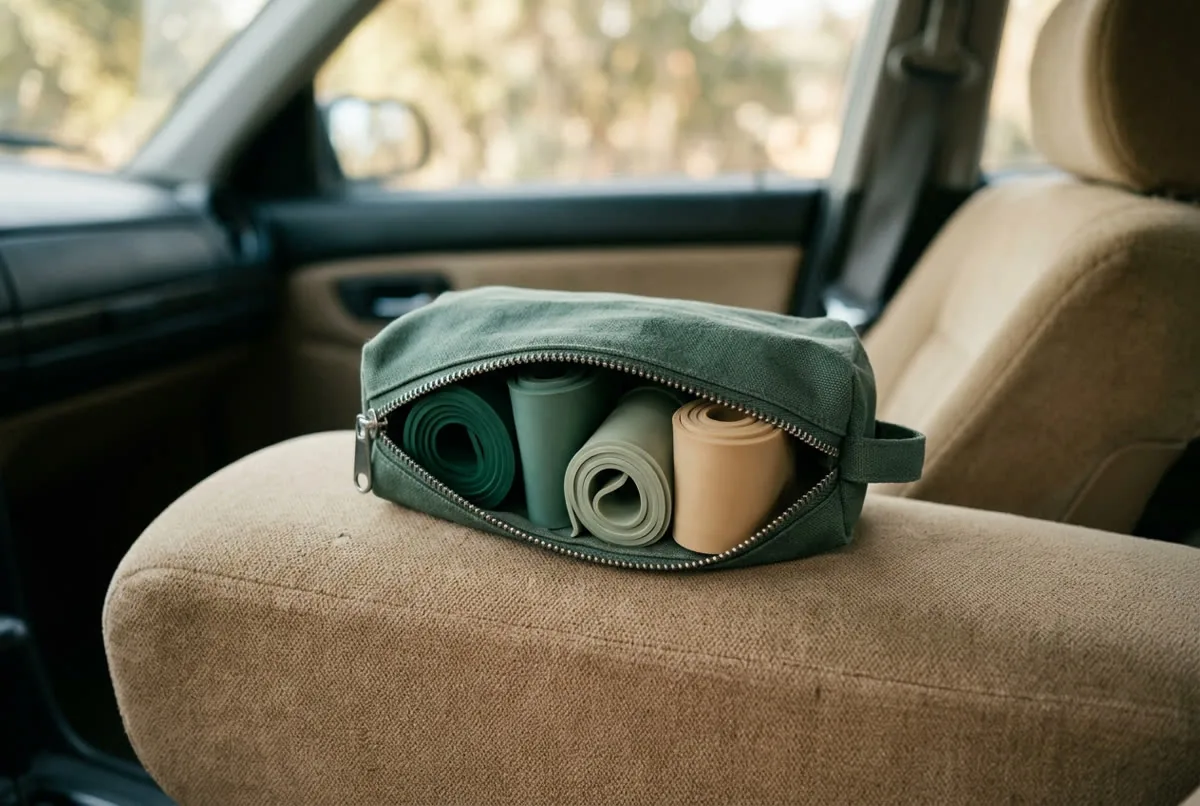
Fall means school pickup lines, practice waiting rooms, and doctor’s office lobbies eating up chunks of your day that used to be free. You are not skipping strength training because you are lazy; you are skipping it because there is no clear 45 minutes left in the schedule. A resistance band kit small enough for your bag or glovebox changes that math, because the workout comes to you instead of the other way around.
The short answer: A compact resistance band kit lets you fit real strength work into carpool lines, waiting rooms, and other small pockets of downtime, and the research on band training in older women shows the gains are not just “better than nothing.”
Why This Is Worth Trying Now
It is tempting to frame a portable band kit as a back-to-school trend, but the better case for it is not seasonal at all. The CDC’s baseline recommendation for adults is muscle-strengthening activity on at least two days a week, working all the major muscle groups (CDC, reviewed 2023-12-06). That is a real, federally set bar, and short band sessions squeezed into a waiting room or a carpool line can help you meet it without a separate gym trip.
There is also a clinical reason this matters beyond convenience. The National Institute on Aging lists age-related loss of muscle mass, called sarcopenia, as a risk factor for falls, and notes that lack of exercise can increase the odds of developing it (National Institute on Aging).
Can Resistance Bands Really Build Muscle Like Weights Do?
This is the question most women ask before they will trust a stretchy piece of rubber over a rack of dumbbells, and it is a fair one.
A randomized controlled trial followed 56 women with a mean age of 67.3 who had sarcopenic obesity through a 12-week elastic-band resistance program. Compared with a no-exercise control group, the band-training group showed a statistically significant gain in total skeletal muscle mass, a mean difference of 0.70 kg at three months (95% CI 0.12 to 1.28, P<0.05), and the benefit was still measurable at the 9-month follow-up (Nature Scientific Reports, 2018-02). That is a peer-reviewed trial in women, not a marketing claim.
Separately, a 2019 study cited by Cleveland Clinic found that resistance-band training provides similar strength gains to conventional gym equipment. A Cleveland Clinic exercise physiologist adds that, in many ways, bands put more tension on your muscles and work them longer during movements (Cleveland Clinic, 2022-05-04).
We are not going to tell you bands replace every tool in a home gym. But “just a warm-up tool” undersells what the research actually shows.
It Is Not Just About Muscle Mass
Muscle mass is one measure, but it is not the one most women actually feel day to day. A 2024 meta-analysis of 12-week elastic-band programs in older women also reported significant changes in functional measures like time to chair rise and gait speed, alongside muscle and bone measures (Journal of Orthopaedics, 2024).
That is the practical payoff of a carpool-line band session: getting out of a low chair without pushing off the armrests, or standing up from the car without a hand on the door frame. Those are the moments a portable kit is actually training for, even though nobody puts “easier to stand up” on a fitness app.
What a Good Portable Kit Actually Includes
Resistance bands started as a strength tool for nursing home residents before they became a mainstream fitness product, and that origin explains their two biggest practical advantages: they fit in a small bag, and you can adjust the resistance by changing the band’s length or its tension level instead of swapping out equipment (Cleveland Clinic, 2022-05-04).
A kit built for travel and short windows of downtime typically bundles a few different resistance levels, color-coded by tension, along with a door anchor or handles, all zipped into a pouch that fits a bag or a glovebox. That combination is what makes carpool-line or waiting-room use realistic in a way a set of fixed dumbbells simply is not. Exact resistance levels, materials, and included accessories vary by product, so check the specifics on the official product page before you buy rather than assuming every kit includes the same pieces.
Carpool-Line and Waiting-Room Moves You Can Actually Do
You do not need privacy or a mat for any of these. All of them work seated or standing next to your car or a waiting room chair, and none of them require you to explain yourself to anyone sitting nearby.
Seated Upper-Body Moves (Car or Chair)
- Seated row: Loop the band around the steering wheel or a stable chair leg, hold one end in each hand, and pull your elbows straight back toward your ribs.
- Overhead press: Sit on the middle of the band with feet hip-width apart, press both handles overhead.
- Bicep curl: Stand or sit on the band, curl the handles up toward your shoulders.
Lower-Body Moves (Standing Beside the Car or a Waiting Room Wall)
- Standing squat with band: Stand on the band with feet shoulder-width apart, hold the handles at shoulder height, and squat as if sitting back into a chair.
- Lateral band walk: Loop a small band around your ankles or just above your knees and take slow side steps, a couple of feet in either direction is plenty of space.
- Glute bridge (if you can lie back in a reclined seat or on the floor at home first, then repeat the setup elsewhere): Loop the band above your knees and press your hips up.
Two short sessions like this a week can count toward the CDC’s minimum strength-training guidance without ever setting foot in a gym, as long as your week covers all the major muscle groups: legs, hips, back, chest, abdomen, shoulders, and arms (CDC, reviewed 2023-12-06).
How to Pick the Right Resistance Level
Most kits are color-coded by tension, from light to heavy, and the honest answer is that you find your starting point by testing it, not by guessing from the color alone. A band that lets you complete a set with the last couple of repetitions feeling genuinely hard, but not so hard that your form breaks down, is in the right range. If you are unsure whether a specific kit’s levels correspond to what you are used to lifting, verify the resistance levels and any lb-equivalents listed on the official product page before you buy, since labeling is not standardized across brands.
Is This Safe If You Have Joint Pain?
Bands let you adjust resistance in smaller increments than most dumbbell sets, and moving through a range of motion under steady tension rather than jerking against gravity can feel gentler on a sore joint for some people. That said, this is not based on a study specific to arthritis or joint pain, so treat it as a general observation rather than medical advice. If you have a diagnosed joint condition, talk with your doctor or a physical therapist before starting a new resistance routine, and stop any move that causes sharp or lingering pain rather than pushing through it.
A lighter band and a smaller range of motion are both reasonable adjustments if a full movement bothers a joint. There is no rule that says you have to do the full seated row range to get value out of the exercise; a shorter, controlled pull that stays pain-free is worth more over weeks than a fuller motion you cannot sustain.
When to Replace a Worn Band
Bands are inexpensive relative to other strength equipment, but they do wear out, and a snapped band under tension can cause a real injury. Cleveland Clinic’s guidance is straightforward: regularly check your bands for signs of wear and tear, since bands exposed to a lot of sun or cold may break (Cleveland Clinic, 2022-05-04). Make that check part of tossing the kit in your bag, it takes a few seconds.
Where This Fits With Other Strength Tools You Might Already Own
If you already have glute bands for hip work, a portable resistance band kit is not redundant, it is a different tool for a different setting. Our glute bands review covers the case for that more targeted piece of equipment if hip strength is your main focus. And if you are weighing whether to invest in a fuller home setup instead of staying portable, our adjustable dumbbells vs. kettlebells comparison walks through that trade-off for a home gym after 40. Bands, dumbbells, and kettlebells are not competing for the same slot in your week, they cover different constraints, and a portable kit’s job is specifically to catch the minutes a fixed home setup cannot reach.
None of this means you need to buy three separate systems at once. A travel band kit is a low-cost, low-commitment way to find out whether short, frequent strength sessions actually fit their week before spending more on equipment that lives in one room.
Your Next Step
Start smaller than feels productive: pick two fixed windows this week, one carpool line and one waiting room, and do a five-minute band session in each. You are not trying to replace a full workout, you are trying to hit the CDC’s twice-a-week strength minimum using time that was already going to be spent sitting there. If it sticks for two weeks, you will have a real habit and evidence about which resistance level actually challenges you, and that is a better foundation than guessing your way through a full kit purchase before you know how you will actually use it.
Frequently Asked Questions
- Can resistance bands actually build muscle as well as dumbbells?
- A randomized controlled trial in 56 women with a mean age of 67.3 found a significant gain in skeletal muscle mass after 12 weeks of elastic-band training compared with a no-exercise control group, with benefits still present at 9 months (Nature Scientific Reports, 2018-02). A 2019 study cited by Cleveland Clinic found resistance-band training provides similar strength gains to conventional gym equipment, and a Cleveland Clinic exercise physiologist notes bands can put more tension on your muscles and work them longer during movements (Cleveland Clinic, 2022-05-04).
- What exercises can I realistically do sitting in a car or waiting room?
- Seated rows using a band anchored to the steering wheel or a chair leg, overhead presses and bicep curls while sitting on the band, and standing moves like squats or lateral band walks next to your car or a waiting room wall all work without a mat or privacy.
- How do I know which resistance band level to start with?
- Most kits are color-coded from light to heavy. A band that makes the last couple of repetitions of a set feel genuinely hard, without breaking your form, is in the right starting range. Exact resistance levels and any lb-equivalents vary by brand, so verify them on the official product page rather than assuming.
- Are resistance bands safe for someone with joint pain or arthritis?
- Bands allow smaller resistance increments and steady tension through a range of motion rather than sudden loading against gravity, which can feel gentler on a sore joint for some people. This is not based on a study specific to arthritis, so it is a general observation, not medical advice; talk with your doctor or a physical therapist before starting a new routine if you have a diagnosed joint condition.
- How often do resistance bands need to be replaced before they snap or wear out?
- Cleveland Clinic advises regularly checking bands for signs of wear and tear, and warns that bands exposed to a lot of sun or cold may break (Cleveland Clinic, 2022-05-04). A band that shows damage is worth replacing rather than using until it snaps.
Sources & references
- Scientific Reports, Elastic band exercise in older women RCT (2018) (opens in new tab)
- Cleveland Clinic, How effective are resistance bands for strength training? (opens in new tab)
- CDC, What counts as physical activity for adults (opens in new tab)
- National Institute on Aging, Falls and fractures in older adults (opens in new tab)
- Journal of Orthopaedics, Elastic band training in elderly women meta-analysis (2024) (opens in new tab)
Before you go
The 7-Day Protein-First Meal Plan for Women Over 40
A complete protein-first week, finished for you: your personal protein target, a one-page shopping list, 21 recipes at 25-35 g protein each, and a timed 90-minute prep schedule. Printable PDF, paired with a free 7-lesson email course.
Free guide
The 7-Day Protein-First Meal Plan for Women Over 40
A complete protein-first week, finished for you: your personal protein target, a one-page shopping list, 21 recipes at 25-35 g protein each, and a timed 90-minute prep schedule. Printable PDF, paired with a free 7-lesson email course.