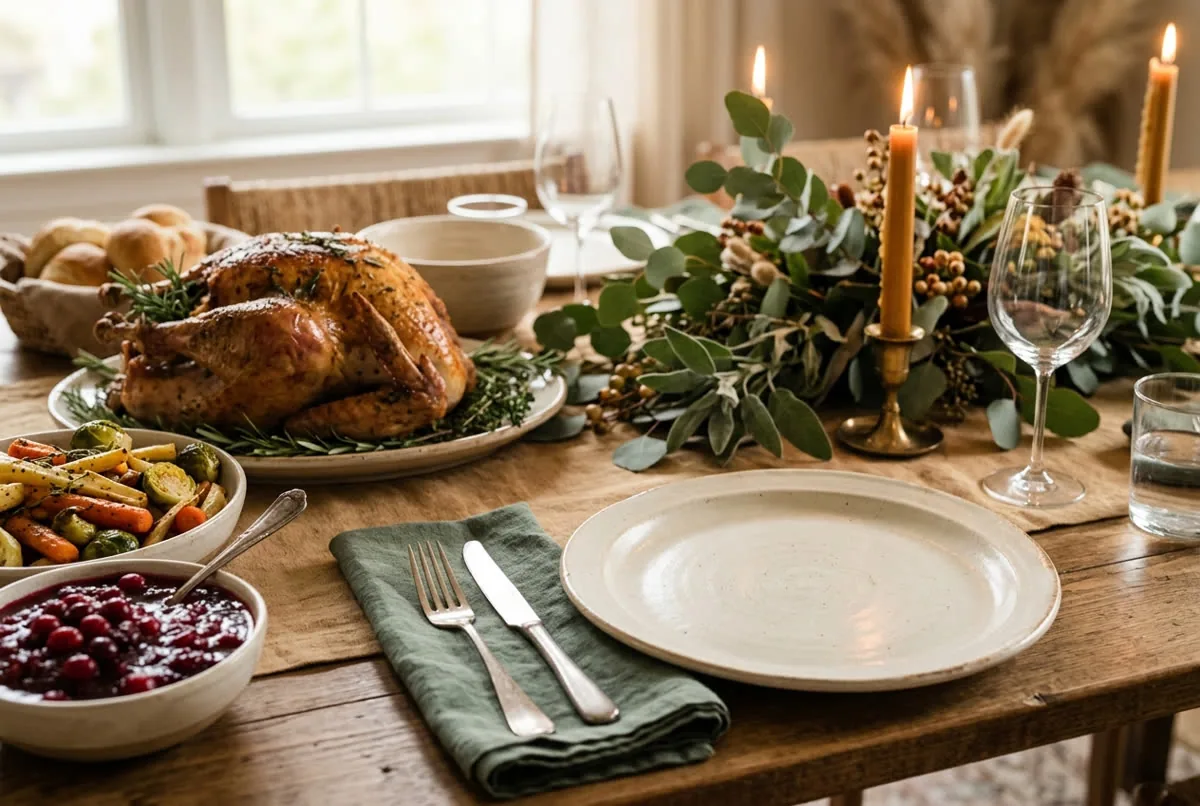
What’s the short answer?
- Build the plate protein-first: about 25 to 30 grams at the Thanksgiving meal supports muscle maintenance.
- Fill half the plate with vegetables and fiber-rich sides to help steady blood sugar.
- Pick two or three favorite dishes on purpose instead of a little of everything.
- Have real dessert, eaten slowly, without guilt.
- Get back to your normal eating rhythm and take a short walk the day after; one meal does not undo months of habits.
Thanksgiving lands on a Thursday in the middle of your normal week, and by Wednesday night you’re already bracing for it. Maybe you’ve spent the last few years treating it as the one day you don’t think about food at all, then spending the weekend feeling heavy and off track instead of rested. If you’re over 40, the stakes feel different: your body doesn’t process a big meal quite the way it used to, and most of the advice online is either “don’t touch the stuffing” or “eat whatever you want, it’s one day,” neither of which actually helps you plan your plate.
The short answer: Build your Thanksgiving plate around protein and fiber first, then use the space that’s left for the dishes you genuinely love. Skip the guilt regardless of what ends up on it. One meal does not undo months of steady habits, and restriction is not what protects your metabolism after 40.
Why This Meal Feels Different After 40
Thanksgiving 2026 falls on Thursday, November 26 (OPM), and for most US households it’s built around one large, high-calorie, high-carbohydrate meal shared with family. That’s true at any age. What changes after 40, especially through perimenopause and menopause, is how your body handles that kind of meal: shifting hormones can affect how you store fat, manage blood sugar, and hold onto muscle, which is part of why menopause-focused nutrition advice leans so heavily on protein, fiber, and steady blood sugar rather than calorie-cutting alone.
None of that means Thanksgiving has to become a stressful math problem. It means the plate you build has more influence over how you feel that evening and the next morning than the plate you built at 30 did. A little intention goes further now, not because your body broke at 40, but because the rules changed.
That distinction matters because it changes the question you’re actually answering. The question isn’t “how do I get through Thanksgiving without ruining anything.” It’s “what does my plate need on it so I still feel like myself at nine o’clock tonight and at seven o’clock tomorrow morning.” Those are two very different problems, and only one of them has a real answer.
How Much Protein Actually Helps at the Table
The current Dietary Guidelines for Americans set a protein target of 1.2 to 1.6 grams per kilogram of body weight per day, and say every meal should prioritize high-quality protein rather than loading it all at dinner (Dietary Guidelines for Americans 2025-2030).
For a woman who weighs around 150 pounds (about 68 kilograms), that range works out to roughly 82 to 109 grams of protein across the whole day. What’s more useful for Thanksgiving specifically is the per-meal picture: research on protein and aging suggests about 25 to 30 grams of high-quality protein per meal maximally stimulates muscle protein synthesis in both younger and older adults (Current Opinion in Clinical Nutrition and Metabolic Care, 2009). A generous serving of turkey, ham, or a plant-based protein main course can cover much of that before a single side dish is added, which is exactly why protein deserves the first spot on your plate, not an afterthought after the sides are already piled high.
If you’re the one hosting or bringing a dish, this is also the easiest lever to pull before the day even starts. A turkey or a bean-based main course you already know you’ll serve doesn’t need to change. What helps is simply serving yourself that protein first, while your plate is still empty, instead of circling the table and filling up on sides before the protein even comes out of the kitchen. Small ordering choices like that do more for how the rest of the meal feels than any rule about what you’re “allowed” to eat.
You Don’t Have to Give Up Stuffing, Pie, or Mashed Potatoes
One of the most common assumptions about eating well after 40 is that Thanksgiving has to become either a day where nothing you eat counts, or a day of white-knuckling past every dish you actually enjoy. Neither serves you well, and both tend to backfire in their own way: the first leaves you uncomfortable and foggy by evening, the second leaves you thinking about pie all through dinner instead of enjoying your family.
The same holds for the idea that you must avoid traditional dishes altogether to stay healthy after 40. Stuffing, mashed potatoes, and pie are not the problem. A plate that’s nothing but stuffing, mashed potatoes, and pie, with no protein or fiber anywhere on it, is what tends to leave you sluggish and uncomfortable a few hours later.
Plate Strategies That Protect Your Blood Sugar and Next-Day Energy
Current US dietary guidance prioritizes protein, vegetables, and fiber-rich whole grains, and calls for significantly reducing refined carbohydrates and avoiding added sugars (Dietary Guidelines for Americans 2025-2030). Fiber matters for blood sugar in particular: your body doesn’t absorb and break it down, so it doesn’t cause a spike the way other carbohydrates can, and soluble fiber slows digestion (CDC). A plate with protein, vegetables, and some fiber-rich carbohydrate is a steadier choice than a plate that’s mostly refined starch.
Alcohol is worth a specific mention here. A glass of wine with dinner is not going to undo anything, but several drinks on top of a very carbohydrate-heavy plate is the kind of combination that tends to leave you feeling worse the next day. If energy the next day matters more to you than anything else on the table, that’s the one variable most within your control.
Timing helps too. Eating slowly, and giving yourself twenty or thirty minutes before deciding whether you want seconds, gives your body time to register that you’re full.
Building Your Plate, Step by Step
None of this requires a food scale at the table or a mental calculator running while your family is trying to talk to you. Think of it as an order of operations, not a set of rules.
Start With Protein
Serve yourself the turkey, ham, or plant-based protein first, before anything else goes on the plate. Aim for a portion roughly the size of your palm to two palms, so this one meal makes real progress toward the 25 to 30 grams per meal that research links to muscle maintenance (Current Opinion in Clinical Nutrition and Metabolic Care, 2009).
Fill Half With Vegetables and Fiber
Green beans, roasted vegetables, a salad if it’s on the table, even the fiber in sweet potatoes or squash, all of it helps slow down how fast the meal hits your bloodstream. This is also where you get toward the 22 to 34 grams of fiber a day that adults are advised to eat, depending on age and sex (CDC).
Choose Your Two or Three Favorites on Purpose
Rather than a small spoonful of everything on the table, pick the two or three dishes you actually look forward to all year, stuffing, your grandmother’s mac and cheese, whatever it is, and give yourself a real, satisfying portion of those. Skip the dishes you’d eat out of habit rather than desire. This is what keeps the meal enjoyable instead of feeling like a checklist.
Have the Dessert You Actually Want
Pie is part of Thanksgiving. Have a slice, sit down, and actually taste it instead of eating it standing at the counter while cleaning up. A dessert eaten slowly and without guilt lands differently, in every sense that matters, than one eaten in a rush while telling yourself you shouldn’t.
What to Do the Day After Thanksgiving
The day after matters more than the day itself. Get back to your normal eating rhythm at your next meal rather than treating the whole weekend as an extension of Thursday. A walk, even a short one, and a protein-forward breakfast do more for how you feel than any amount of guilt ever will. Leftovers are not a problem to solve either. A turkey sandwich or a plate of reheated sides the next day is still just food, not evidence that Thursday went wrong.
If cortisol and stress around holiday eating are part of what’s been working against you, our breakdown of cortisol and belly fat after 40 covers what the research actually supports and what’s overhyped. And if you’re looking for ways to keep your energy steady through the rest of the season, not just for one meal, 9 Fall Foods for Steady Energy After 40 is a useful next stop for building that into your regular week.
Your Next Step
You don’t need a perfect Thanksgiving plate. You need one that has protein on it, some fiber, and room for the two or three dishes that make the day feel like Thanksgiving. If you’re looking for a simple, structured plan to lean on once the holiday season settles down, a plan built around smoothies, like The Smoothie Diet, is one option that doesn’t add another set of complicated rules to track. Whatever you choose, the goal this year is the same one that actually works after 40: steady, not perfect.
Frequently Asked Questions
- How much protein should I aim for at Thanksgiving dinner?
- Research on protein and aging suggests about 25 to 30 grams of high-quality protein per meal to support muscle maintenance, and a generous serving of turkey, ham, or a plant-based main can cover much of that (Current Opinion in Clinical Nutrition and Metabolic Care, 2009).
- Do I need to avoid dessert altogether after 40?
- Not for one holiday meal. Current US dietary guidelines do not recommend added sugars, so dessert is best kept occasional, but a real portion of the dessert you actually want, eaten slowly, can sit on a plate built around protein and vegetables.
- What actually helps with post-Thanksgiving energy and blood sugar?
- Current US dietary guidance prioritizes protein, vegetables, and fiber-rich whole grains while cutting back on refined carbohydrates and added sugars, and fiber does not spike blood sugar the way other carbohydrates can (CDC).
Sources & references
Before you go
The 7-Day Protein-First Meal Plan for Women Over 40
A complete protein-first week, finished for you: your personal protein target, a one-page shopping list, 21 recipes at 25-35 g protein each, and a timed 90-minute prep schedule. Printable PDF, paired with a free 7-lesson email course.
Free guide
The 7-Day Protein-First Meal Plan for Women Over 40
A complete protein-first week, finished for you: your personal protein target, a one-page shopping list, 21 recipes at 25-35 g protein each, and a timed 90-minute prep schedule. Printable PDF, paired with a free 7-lesson email course.